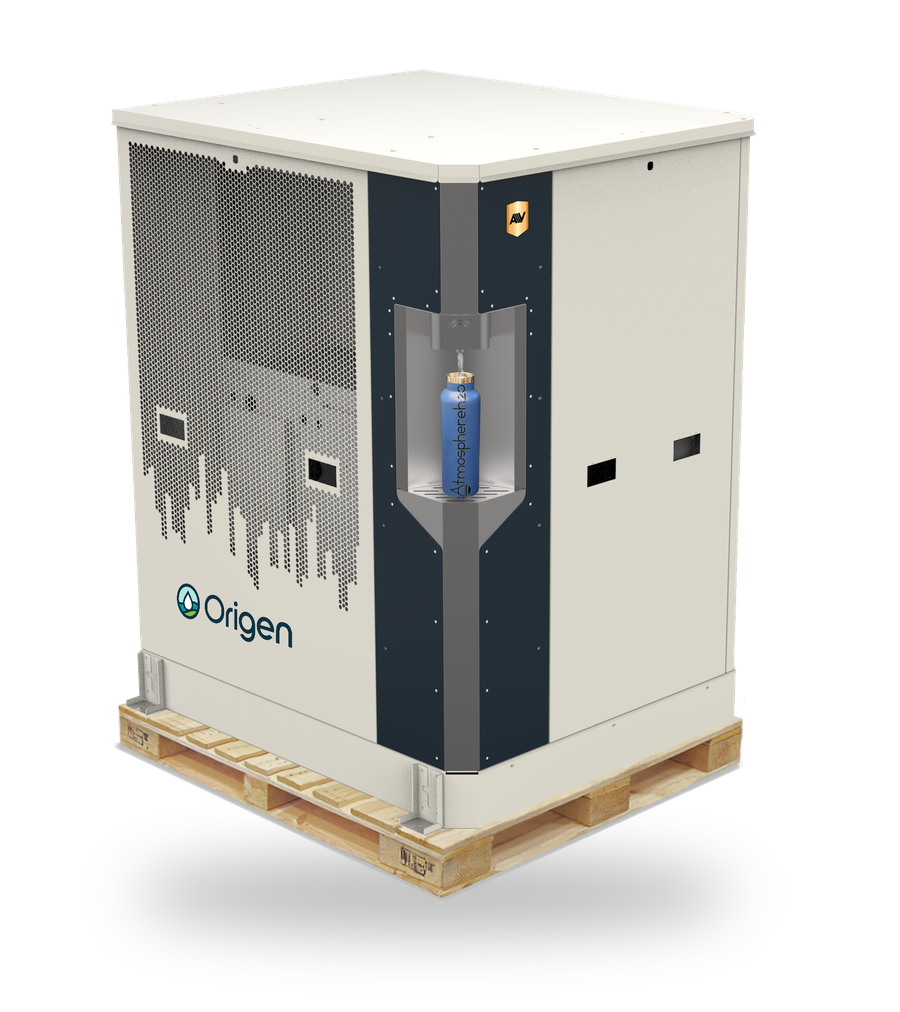
Meet Origen
One machine. Endless water.
The Origen Self-Filling Water Kiosk makes its own drinking water from the air — and even gives you cleaner air in return.

The Gold Standard. Zero compromise. Starting with instant plug-n-play water security & resilience.™
Origen — the award-winning Self-Filling Atmospheric Water Generator Kiosk.
100+ gallons of pure drinking water a day, made on site from the air. No well, no water main, no delivery truck — and you're the one who solved water. In service today.
Built for
We sell to organizations only — business, government, schools, charities and NGOs.
Our Mission
Your water problem, solved on site.
An atmospheric water generator that makes pure drinking water from the air — right where you need it.
The Problem
Your guests, students, patients or crew drink whatever the pipe delivered. Roughly 90 of the 84,000+ chemicals in U.S. commerce are regulated in drinking water; PFAS and microplastics now turn up in human blood. You cannot test your way out of a system you do not control.
Aging mains, boil notices, contamination events, and a projected ~$800B national funding shortfall by 2030. You can wait for someone else to fix the infrastructure, or you can start making your own water this quarter.
Your project stalls on water logistics, hookups and permits — often on land that is otherwise perfect. A self-hosted micro-utility turns “no permit” into “break ground.”
One pipe, one plant, one grid. A single-source dependency is a liability whether the threat is a storm, a drought, a contractor with a backhoe, or something deliberate. Generating on site removes the target and the dependency together.
Water is heavy, slow, expensive and exposed — 8.3 lb a gallon, every gallon, every day, forever. Generating on site collapses the supply line instead of shortening it. At the standard rating condition, one gallon of generator diesel yields roughly 12 gallons of drinking water — more than that in humid air. Twelve gallons of water weighs 100 lb; the diesel weighs seven, and you are already hauling it.
Whichever one is yours — the answer is the same machine.
The Solution
Every glass of water you have ever drunk was in the atmosphere first. Rain is atmospheric water — condensed, fallen, and then made to travel through ground, rock, reservoir and pipe before it reaches you. Origen takes the same water at the origin, before any of that happens.
Pulled from ambient humidity. Zero microplastics by design, NSF/ANSI 61 wetted materials and UV-C purity, plug-and-play. No well, no main, no permit to drill anything.
We make a controlled amount of rain inside the machine. Once it's consumed, that water returns straight to Nature's cycle. We borrow a glass and give it right back.
The highest measured water-per-watt in the category, at a published rating condition — pure water where and when it's needed.
Nature's Water Cycle
Origen doesn't invent anything nature isn't already doing. It runs the same four steps — on demand, in a sealed cabinet, in about ninety seconds instead of nine days.
Evaporationmist lifts off the lake
Condensationthunderhead builds
Precipitationrain falls
Riverdown the valley
Lake or Oceancollects · and lifts again

absolute humidity in →
→ clean water out
consumed → returns to the lake · we borrow a glass and give it right back
Sun lifts water off the ocean. It condenses into cloud, falls as rain, runs back to the sea. The loop is perfect — and it takes days to weeks, wherever the weather decides.
The sun lifts water off oceans, lakes and soil into the air as vapor. At any moment the atmosphere holds thousands of cubic miles of fresh water.
Air cools past its dew point and vapor becomes liquid again. Origen does this on purpose, on demand, inside a sealed cabinet.
Filtered, sterilized and remineralized to 60–70 TDS, then held in a 50-gallon vessel and dispensed on demand.
Every drop consumed re-enters the same cycle. Nothing is drawn from a watershed, an aquifer or a neighbor's supply.
Measured, not claimed
Highest measured water-per-watt of any atmospheric water generator, at the published ASHRAE 80°F / 60% RH rating condition.
Competing machines publish their output at a condition wetter than the standard — which is why brochure gallons and delivered gallons rarely match.
We publish the expected output for your actual location, month by month — including the places where we perform poorly.
Every figure is the manufacturer's own published specification. Full ranking, methodology and sources: the AWG efficiency database.
What You're Actually Getting
A weatherized cabinet that pulls drinking water from the air. No well. No pipe. No permit.
Water is sustainably produced from Nature's own water cycle, eliminating the need for bottled water logistics.
Compatible with renewable energy and scalable without centralized distribution and costly infrastructure.
Zero microplastics. Zero chemicals. Just clean water, certified to NSF/ANSI standards.
The Machine That Makes It Real
See your city's water output — modeled for 167 locations from real weather data.
Explore OrigenOur Mission
Origen pulls pure drinking water out of thin air, then filters, mineralizes, and serves it — no source line, no delivery truck. Here is exactly how it works, in one scroll.
Meet Origen
The Origen Self-Filling Water Kiosk makes its own drinking water from the air — and even gives you cleaner air in return.

How it works
It's not magic, it's great engineering. Air is drawn in, condensed to water, purified, mineralized, and dispensed — all on site.

The experience & your brand
One-touch stainless-steel dispense for a bottle, glass or jug — and a brandable face that is a natural canvas for your wrap, a sponsor, or a co-brand.
Yes, you can wrap it in digital camouflage.

Built to deploy
Weatherized and forkliftable on a compact palletized base — resort deck, school yard, base, or remote site.

That is our market. We support fleet orders from 10 to 10,000+ units. Use this link to access our sales intake form.
Fleet Sales Intake FormOrigen Wellspring 100
We sell to businesses, governments, schools, charities and NGOs — not to the general public. Tell us what you're trying to solve and a person will answer, usually same business day.
The Learning Bench · Psychrometrics
An atmospheric water generator doesn't make water. It harvests water that is already in the air. So the single biggest driver of how much you get is not the machine — it's how much water the air was carrying when it arrived. Change the rating condition and you change the answer, without touching the hardware.
The gap is 64%. A kilogram of 30°C/80% air carries about 21.6 grams of water; the same kilogram at the standard condition carries about 13.2. And because its dew point is roughly 14°F higher, the machine has to work far less to reach the point where water starts forming at all. Those two effects compound. Rate a machine in monsoon air and its efficiency figure can rise 60–80% with no engineering change whatsoever.
This is why we publish at the standard condition and then tell you what to expect at your site, from your location's real temperature and humidity through the year — not a single flattering number from the wettest week of the year in the wettest place on earth. Inflated brochure figures are the main reason buyers have been burned by this category, and it is the expectation gap, not the physics, that has held the industry back.
Dan Dettmers, a co-inventor of the M-CoRR™ core, on the engineering realities behind it — why recovering the cold is harder than it sounds, and what it took to make it work in a production cabinet.
The Learning Bench · The Benchmark
Moisture-removal machines produce wildly different results depending on the air you feed them. Left to themselves, manufacturers would each publish at whatever condition flattered their hardware most, and no buyer could compare anything. So the industry fixed a common rating point.
AHAM condition vs “saturation” condition. The appliance industry already has a name for the other end of the scale. A saturation rating is taken in hot, nearly-saturated air — conditions that produce the largest possible number and that indoor environments almost never reach. Both figures can be honestly measured. Only one of them tells you what to expect on a Tuesday in your building.
A warm, humid but ordinary day. Achievable across most of the inhabited world for much of the year.
Maximum-output conditions. Real in a monsoon, rare anywhere you would install a machine and expect that number every day.
Every figure in our comparison is each manufacturer's own published number. Where a manufacturer publishes at a wetter condition, we convert it to 80°F / 60% RH so the machines sit on one axis. We do not restate anyone's marketing claim as a defect — we simply put every machine on the same air.
Sources: AHAM DH-1-2022, Association of Home Appliance Manufacturers · U.S. Department of Energy, Test Procedure for Dehumidifiers (final rule) — incorporates AHAM DH-1-2022 by reference and records the 80°F → 65°F change made in DH-1-2017